Back
Harnessing AI and Machine Learning to Revolutionize Antenna Design & Optimization
By - Nithin Raj S Sep 18, 2025 5 Minutes

Antennas are the invisible enablers of wireless communication, connecting our devices and satellites.
Traditionally, designing RF antennas has been a complex, time-consuming process involving extensive simulations and expert knowledge. But today, artificial intelligence (AI) and machine learning (ML) are transforming how antennas are designed, optimized, and deployed—making the process faster, more efficient, and accessible to engineers at all levels.
The Challenge of Traditional Antenna Design
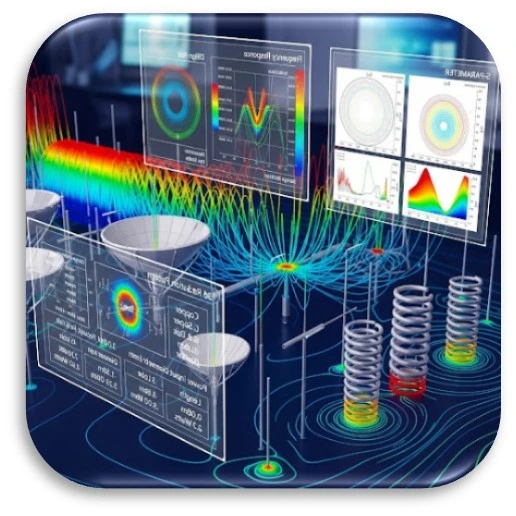
Designing effective antennas involves tuning multiple parameters such as shape, size, materials, and frequency bands to achieve desired performance metrics like gain, bandwidth, and radiation patterns.
Conventional methods rely heavily on full-wave electromagnetic (EM) simulations, which demand specialized expertise and careful model setup, making it challenging to efficiently explore large design spaces or unconventional geometries.
How AI and ML Are Changing the Game for Antenna Engineers
AI-powered antenna design adapts by learning complex relationships between design parameters and antenna performance from data, enabling:
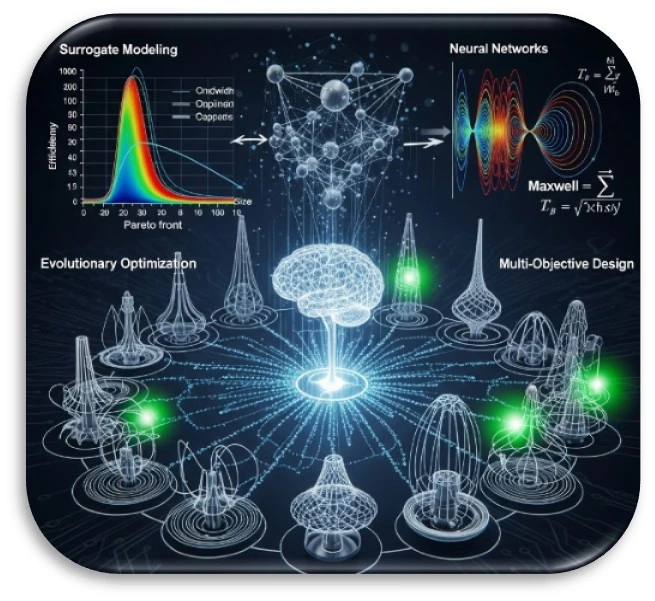
Surrogate modelling: ML models (like neural networks) approximate antenna responses, drastically reducing the need for expensive simulations
Rapid optimization: Evolutionary algorithms, genetic algorithms, and reinforcement learning guided by ML quickly search for optimal designs, balancing multiple performance objectives such as size, efficiency, and bandwidth.
Multi-objective design: AI finds Pareto-optimal trade-offs, enabling antennas that meet conflicting demands (e.g., maximize gain while minimizing size).
Domain knowledge integration: Physics-informed ML models incorporate electromagnetic theory, improving prediction accuracy and speeding up training.
Popular AI and ML Techniques in Antenna Design
Neural Networks (ANN, CNN): Learn nonlinear mappings from geometry to antenna characteristics like radiation pattern and impedance.
Decision Trees, Random Forests, Gradient Boosting (CatBoost, XGBoost): Provide interpretable surrogate models for fast antenna parameter predictions.
Evolutionary Algorithms: Mimic natural selection to evolve antenna shapes with better performance.
Design of Experiments (DoE) combined with ML: Systematically generate training data to efficiently explore design spaces.
Practical Workflow Example: The AI-Driven Loop

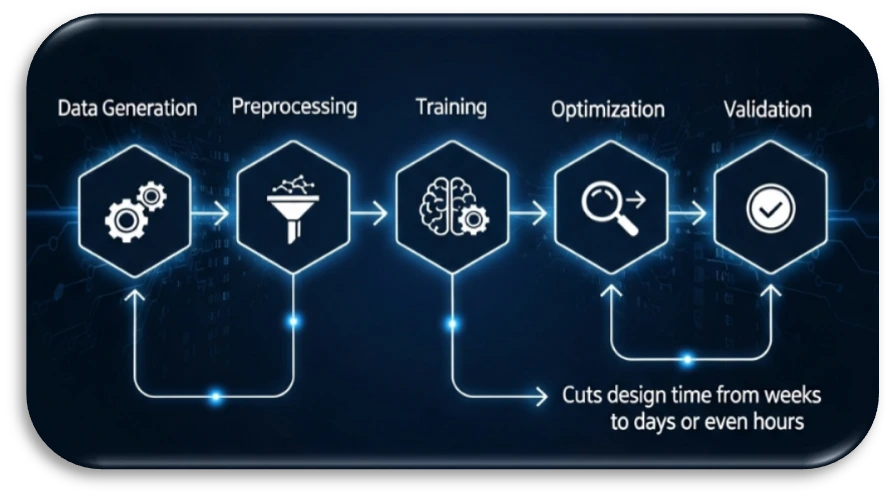
Data Generation: Use EM simulation or physical measurements to generate a dataset of antenna designs and their performance
Preprocessing: Normalize and select relevant features to train the ML model
Training: Develop surrogate models that can predict antenna behaviour with high accuracy
Optimization: Employ ML-driven optimization algorithms to find antenna parameters that meet design goals rapidly
Validation: Verify optimal designs through final simulations or prototyping
This AI-driven loop cuts design time from weeks to days or even hours.
AI in Smart and Adaptive Antennas
Beyond design, AI enhances smart antenna systems enabling:
Real-time beamforming: ML algorithms dynamically steer antenna beams toward users to improve signal strength and reduce interference in dense environments like smart cities and IoT networks
Reconfigurability: AI adapts antenna properties (frequency, polarization, phase) on the fly for optimal performance under changing conditions
User tracking: Intelligent antennas track mobile devices seamlessly, supporting autonomous vehicles, VR/AR, and next-gen communications
This AI-powered technology helps smart antenna systems adapt in real-time, enhancing overall performance and enabling next-generation communication networks

The Road Ahead: Future of Antenna Technology

Physics-informed deep learning: Using antenna physics as constraints to improve AI model reliability.
Transfer learning: Adapting models quickly to new antenna types and frequency ranges with minimal retraining.
Edge AI for embedded antennas: On-device real-time optimization and adaptation.
Integration with flexible, wearable antennas: Enabling intelligent textile communication and sensing.
These cutting-edge research directions will shape the future of antenna technology, enabling smarter, more adaptable communication systems.
Conclusion: The Future of Connectivity
AI and machine learning are revolutionizing antenna design and deployment by providing faster, smarter, and more adaptable solutions. They empower engineers to explore innovative geometries, optimize multiple performance targets, and develop intelligent antenna systems critical for the future of connectivity—from handheld devices to smart cities and beyond.
Harnessing AI-driven design and optimization will be key to meeting the increasing demands of wireless communication and IoT applications in a scalable, efficient, and cost-effective manner.